




The demand for residential proxies has grown rapidly over the past few years—especially across use cases such as web scraping, social media management, sneaker bots, SEO, advertising, and data analytics. As websites continue to tighten their bot-detection systems, traditional datacenter IPs are no longer safe or effective enough.
Do you already know what a residential proxy is?
If not, you can check out my article “What Is a Residential Proxy?”, where I explain the definition and underlying structure in detail.
However, if you’re already experienced, fully understand how residential proxies work, and are actively searching for the keyword “buy residential proxy”, then what you really need right now is not more theory—but choosing the right provider, the one you’re about to spend money on.
This article will walk you through the most important factors to consider before buying residential proxies, helping you avoid wasted budget and unnecessary risks in 2025.

Comparison between residential proxy and datacenter IP under website bot detection systems
Understanding Residential Proxies Before You Buy
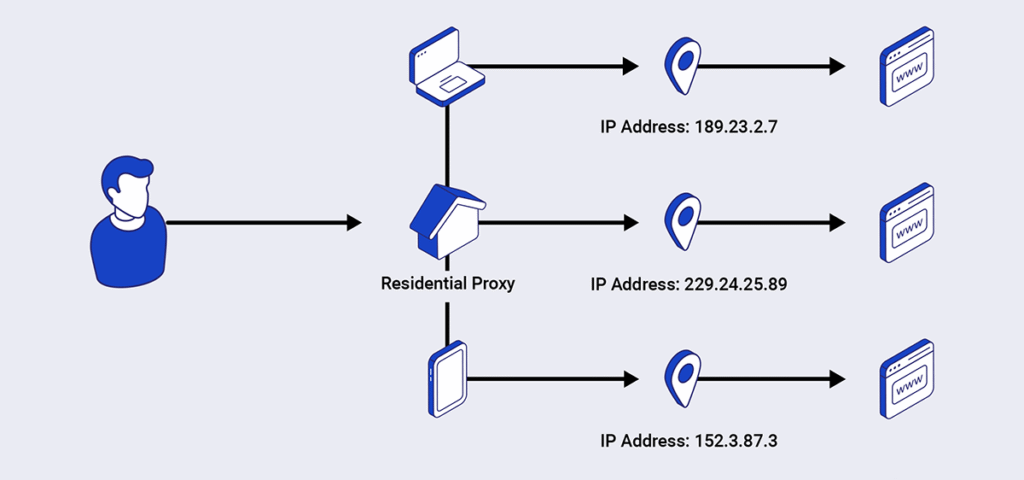
Diagram showing how a residential proxy routes traffic through real user devices provided by ISPs
A residential proxy is an IP address assigned to a real user device by an Internet Service Provider (ISP). When you access a website through a residential proxy, your traffic appears exactly like that of a normal household internet user.
As a result, residential proxies are:
- Harder to detect
- Less likely to be blocked
- More trusted by websites
That said, not all residential proxy providers are created equal. The real differences lie in pricing models, IP quality, IP pool size, rotation control, and the level of customer support.
1. Pay by Bandwidth or Pay by IP?
Residential proxy pricing models comparison between bandwidth based and IP based plans
This is the first thing you should clearly understand before making a purchase.
Bandwidth-Based Pricing (GB-Based)
With this model, you pay based on the amount of data transferred through the proxy.
Best suited for:
- Large-scale web scraping
- Continuous data crawling
- High-volume requests with frequent IP rotation
Pros:
- Highly flexible
- No fixed limit on the number of IPs
- Ideal for automation
Cons:
- Bandwidth can be consumed very quickly if requests are not controlled
- Forgetting to stop a task overnight can result in an unexpectedly large bill
- Not ideal for long sessions
IP-Based Pricing
With this model, you pay to use a fixed number of IPs over a set period of time.
Best suited for:
- Managing social media accounts
- Logging in and warming up accounts
- Maintaining stable IP sessions over time
Pros:
- Stable sessions
- Easier cost control
- Great for social media and e-commerce accounts
Cons:
- Less flexible
- Not optimal for large-scale scraping
Most providers today offer both options—choose the model that matches your use case.
2. IP Pool Size: Bigger Usually Means Safer
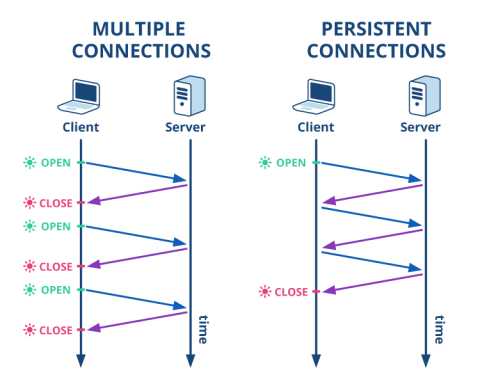
Residential proxy IP pool size comparison showing large versus small IP pools and reuse risk
An IP pool is the total number of residential IPs a provider has available. This is a critical factor that directly impacts safety and long-term reliability. In general, the larger the pool, the better.
Why does a large IP pool matter?
- IPs are reused less frequently
- Lower risk of blacklisting
- Less fingerprint overlap
- Higher trust when accessing sites with strict bot-detection systems
Practical benchmarks:
- Under 1 million IPs: high risk for scraping or automation
- 5–10 million IPs: solid mid-range
- Over 10 million IPs: best for enterprise and large-scale workloads
If a provider won’t disclose their IP pool size or avoids the topic, that’s a sign you should be cautious.
3. Geo-Targeting
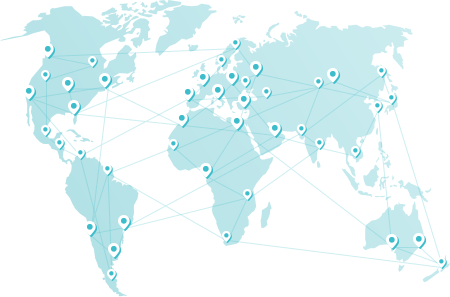
Geo-targeting allows users to select specific countries, cities, or ISPs when accessing websites through residential proxies.
Location targeting is one of the main reasons people buy residential proxies instead of cheap proxy alternatives.
Common levels of geo-targeting:
- Country-level
- State/region-level
- City-level
- Specific ISP or ASN
When geo-targeting becomes essential:
- Checking local search results
- Ad verification
- Managing region-based social media accounts
- Comparing e-commerce pricing across countries
A strong provider lets you select a precise location, rather than rotating random IPs globally.
4. Rotation Control
If you’re new, you might ask: “Does it rotate IPs?”
But experienced users ask: “How much control do I have over rotation?”
Common rotation options:
- Automatic rotation: IP changes on every request
- Sticky sessions: keep the same IP for 5, 10, or 30 minutes
- Manual rotation: rotate via API or dashboard whenever you choose
For complex workflows, rotation control matters more than raw IP count.
Based on real-world usage, I’ve found that residential proxies with poor rotation controls tend to trigger CAPTCHAs much faster, even when the IP pool looks large on paper.
A reputable provider offers flexible customization—not fully random IP behavior that you can’t control.
5. IP Quality: Not All “Residential” IPs Are Clean
Just because it’s labeled residential doesn’t automatically make it safe.
You should check:
- Whether the IPs truly come from real devices
- Whether the IPs are overshared among too many users
- Whether the IPs have a history of spam or bot traffic
Low-quality IPs often lead to:
- Fast blocks
- Constant CAPTCHAs
- High request failure rates
Cheap pricing often comes with abused IPs.
6. Support & Documentation
This is the part many people overlook—and it’s also where weak providers reveal their biggest flaws.
Before you buy, check:
- Do they offer 24/7 support?
- Live chat or only tickets/email?
- Is the documentation clear and up to date?
- Do they provide API integration guides?
- Is the dashboard easy to use?
Strong providers invest in documentation and support because their customers are developers, marketers, and agencies—people who need stability, not friction.
7. Warning Signs When Choosing a Provider
Be cautious if you notice:
- They don’t disclose IP sourcing
- Pricing is far cheaper than market average
- No test, trial, or refund option
- Weak or incomplete documentation
- Support is slow, vague, or evasive
If a provider can’t clearly explain how their IPs are supplied, treat it as a serious red flag.
Buying Residential Proxies Is a Technical Decision—Not Just a Price Comparison
Residential proxies aren’t cheap, and choosing the wrong provider can lead to:
- Project interruptions
- Account bans or losses
- Wasted budget
- Lower automation performance
Instead of looking for the cheapest option, look for a provider that is transparent, stable, and aligned with your use case.
If you’re planning to buy residential proxies in 2025, make sure your provider offers:
- Clear pricing models
- A large, clean IP pool
- Flexible geo-targeting
- Full rotation controls
- Professional support and documentation
These factors separate serious proxy providers from everyone else.

